
See where the Russet Cider Trail will take you
Bishops Lydeard to Norton Fitzwarren – the aim is to start as close to the steam railway station as possible and then roughly follow the railway line to enter into Norton Fitzwarren adjacent to the recreation ground on the west side of the village.
In due course as the proposed bypass is built the aim will be to cross beneath the road and then join up with the new cycle path into Taunton and Wellington.
Bishops Lydeard to Cotford St Luke runs partway alongside the railway line and then branches off south to use existing rights of way or construct a dedicated path to access the centre of the village.
By linking the routeway to the West Somerset Railway it will have a much greater impact enabling people to travel both alongside the line and in time by train to Taunton, and the national rail network. The WSR itself can also bring cyclists by train from Minehead and the communities of West Somerset to the area.
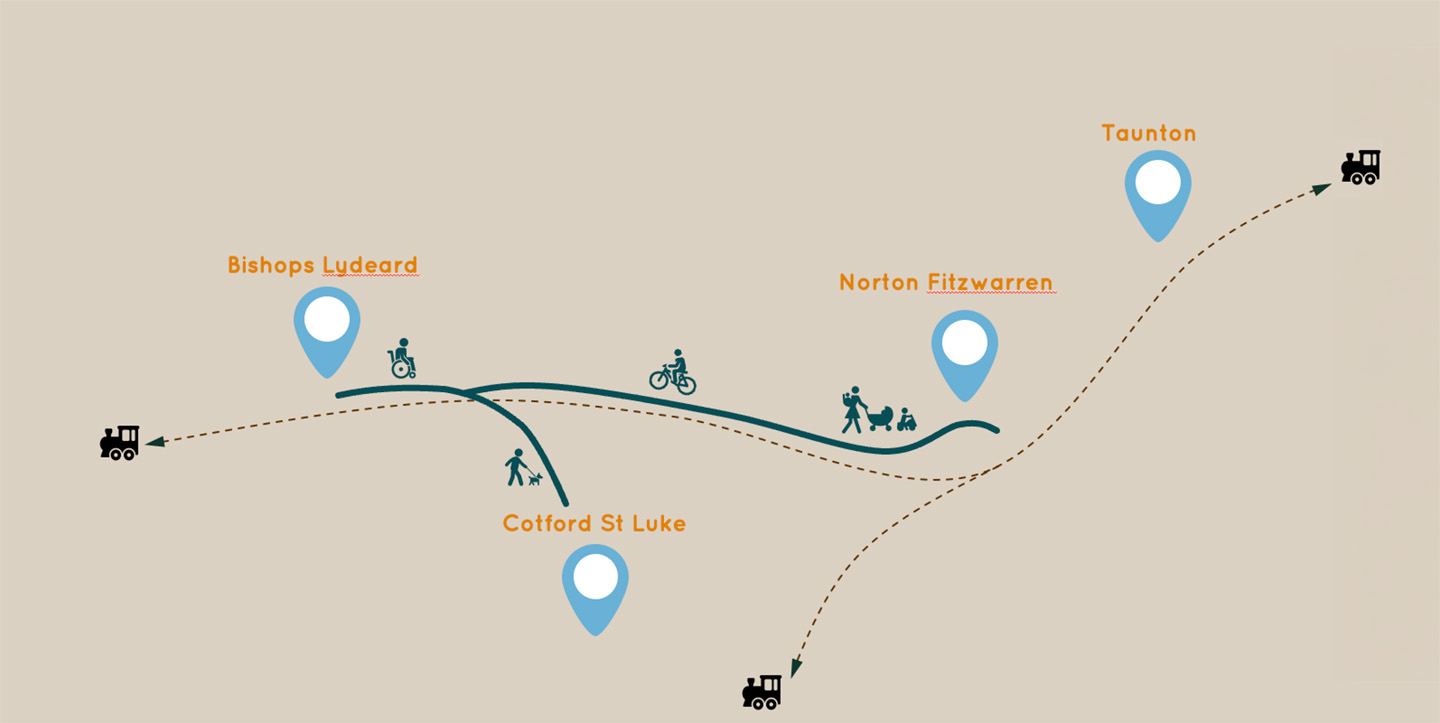
Norton Fitzwarren is the largest community and an entry point to Taunton for those travelling from Bishops Lydeard and Cotford St Luke as it has existing cycleway/walkway connections to Taunton. It is much more like a small town and has many services. Apart from a footpath that is lightly used and subject to flooding its links to BL and CSL are by fast, busy and frequently congested A roads.
Bishops Lydeard is an historic Quantock village that in recent years has seen a significantly increased population, over-crowded roads.
It is a hub and main entry point for the West Somerset Railway heritage railway, which is the longest in the country and brings large numbers of visitors to the area.
Cotford St Luke is a planned and growing community that shares poor links with its two neighbours, Bishops Lydeard and Norton Fitzwarren, although it is only several fields distant from Bishops Lydeard.

This route is intended to be as safe, accessible and inclusive as possible, providing a welcoming shared-use trail for people of all ages, confidence levels and physical abilities. Its design should support everyday use by pedestrians, cyclists, wheelchair users, mobility scooter users, families with pushchairs, older people and those who may find uneven, narrow or road-adjacent routes difficult or intimidating.
Wherever practical, the path should be constructed to recognised national standards for Active Travel and shared-use routes, with careful attention to width, surface quality, gradients, visibility, resting points, access controls, crossings, drainage, signage and ongoing maintenance. The aim is to create a route that is not only safe in principle, but comfortable, practical and dependable in real everyday use.
By designing accessibility into the route from the outset, rather than treating it as an afterthought, the trail can become a genuinely inclusive community asset. It should offer a safer alternative to busy roads while enabling more people to walk, wheel or cycle between local villages and towards Taunton for leisure, commuting, school journeys, exercise and everyday travel.